By Maria Kyriakou
Director | ISOFormuLab
Maria Kyriakou is the Director of ISOFormuLab and a Management Systems Consultant, Lead Auditor and HRDA Certified Trainer. With extensive experience in Management Systems, she supports organisations in developing, implementing and improving practical solutions in the areas of Health & Safety, Quality and Management Systems Compliance, helping businesses move beyond compliance towards operational excellence. Management Systems Consultant | Lead Auditor | HRDA Certified Trainer
Every hotel invests significant resources in upgrading its facilities, enhancing service quality, and creating memorable guest experiences. Yet there is one area that, if not managed effectively, can undermine years of investment in a matter of hours: Health & Safety.
The hospitality industry is one of the most important pillars of the Cypriot economy, but it is also one of the most demanding working environments. On any given day, a hotel accommodates hundreds of guests while employees carry out a wide range of activities—from housekeeping, food preparation and service, and building maintenance to pool and spa operations, chemical handling, landscaping, baggage handling, and many other essential tasks.
Each of these activities presents its own occupational hazards and requires proper planning, continuous risk assessment, and effective management.
Although most hotels recognise the importance of Health & Safety, my experience has shown that, in many cases, it is still viewed primarily as a compliance obligation rather than a management tool for preventing incidents and protecting people.
During audits and training sessions, I often hear the same response:
“Our Risk Assessment is in place, and we have Health & Safety procedures.”
My response is always the same.
The real question is not whether these documents exist.
The real question is whether they are being used.
A Risk Assessment that remains in a drawer does not protect anyone, nor does it reduce the likelihood of an accident. Likewise, Health & Safety procedures that are only reviewed when an inspection is scheduled fail to serve their true purpose. These documents should guide day-to-day decisions, supporting the safety of employees, contractors, and ultimately, hotel guests.
Compliance Is the Starting Point. Not the Goal
It is easy to assume that Health & Safety is simply about complying with legislation or avoiding regulatory penalties.
In reality, effective Health & Safety management has a direct impact on every aspect of a hotel’s operation.
It protects employees.
It safeguards guests.
It supports business continuity.
It protects the organisation’s reputation.
And above all, it reflects the commitment of management to the people who make the business successful.
Legislation establishes the minimum legal requirements. The real challenge, however, is to build an organisation where prevention is embedded in everyday operations rather than treated as a compliance exercise.
In Cyprus, the Safety and Health at Work Law of 1996 (Law 89(I)/1996), as amended, requires every employer to ensure, so far as is reasonably practicable, the safety, health and welfare of employees at work. These responsibilities also extend to protecting visitors, contractors, subcontractors and other third parties who may be affected by the organisation’s activities.
The legislation requires employers to identify workplace hazards, assess risks, implement appropriate preventive measures, provide suitable information and training, ensure safe working conditions, and review control measures whenever operational changes occur.
However, compliance is not achieved simply by preparing a Risk Assessment and maintaining Health & Safety procedures.
That is where compliance begins. Not where it ends.
Safety Culture Starts with Leadership
The organisations that achieve the greatest reductions in workplace incidents are not necessarily those with the most extensive Health & Safety management systems.
They are the organisations where leadership genuinely believes in prevention.
Where managers discuss safety with their teams every day.
Where near misses are reported, investigated and used as opportunities for improvement.
Where training is delivered not simply to complete a training record, but to influence behaviours and develop competence.
Where the Risk Assessment is treated as a management tool that supports day-to-day decision-making, rather than a document that is only reviewed when an inspection is approaching.
Health & Safety cannot be effective without visible leadership and genuine management commitment.
If Managers fail to lead by example, if procedures are bypassed for the sake of convenience or speed, or if training is treated as a box-ticking exercise, then even the most comprehensive management system will remain little more than paperwork.
A strong safety culture always starts with leadership and is reinforced every day at every level of the organisation.
Throughout my career, I have visited organisations with comprehensive Health & Safety procedures and well-developed Risk Assessments. Yet when an employee was asked how they would respond to a chemical spill or another serious emergency, they simply did not know.
That is the difference between formal compliance and a genuine safety culture.
A Risk Assessment Is Not a Document. It Is a Management Tool
One of the most common issues I encounter is that Risk Assessments and Health & Safety procedures are often treated as documents that are reviewed only when required or shortly before an audit or inspection.
Their real value, however, lies not in their existence, but in how they are used.
A Risk Assessment should inform every significant operational decision within a hotel.
Before new equipment is purchased.
Before a work process is changed.
Before a new chemical is introduced.
Before a new task is assigned.
Before a new employee begins work.
For example, introducing a new cleaning chemical, replacing laundry equipment, or changing a swimming pool maintenance procedure should always be preceded by a review of the associated risks and appropriate staff training.
When used effectively, a Risk Assessment enables management to identify hazards early, prioritise corrective actions, and prevent incidents before they develop into accidents.
The Greatest Investment Is Not Equipment. It Is People
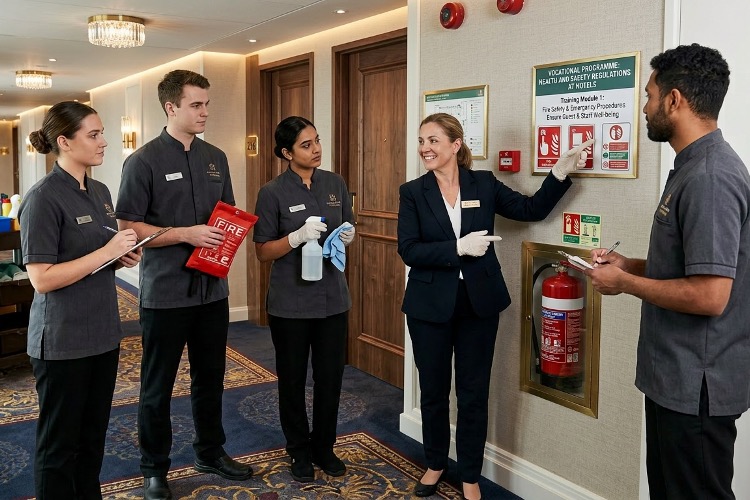
Another aspect I consider particularly important is training.
There is still a common misconception that Health & Safety is primarily the responsibility of the Health & Safety Officer, the Safety Committee, or senior management.
The reality is very different.
Health & Safety is everyone’s responsibility.
The housekeeper who cleans dozens of rooms every day.
The chef working with hot surfaces, boiling oil, and sharp kitchen equipment.
The maintenance technician carrying out electrical or mechanical work.
The pool operator responsible for handling treatment chemicals.
The spa therapist.
The groundskeeper.
The front office employee who may be the first person required to respond in an emergency until professional assistance arrives.
Legislation requires employers to provide appropriate Health & Safety information, instruction and training relevant to each employee’s role and responsibilities.
This is not simply a legal obligation.
It is arguably the most effective preventive measure any organisation can implement.
When Prevention Fails
In recent years, serious incidents in hotels, both in Cyprus and internationally, have served as a stark reminder that a single procedural failure, oversight, or lack of training can have significant human, legal, and business consequences.
A serious workplace accident involves far more than the immediate cost of the incident itself. It is often accompanied by lost working hours, operational disruption, increased operating costs, compensation claims, regulatory investigations, and lasting reputational damage.
Incidents involving swimming pool operations, chemical handling, maintenance activities, and other critical hotel functions have resulted in serious injuries, loss of life, criminal investigations, and extensive media attention.
Regardless of the outcome of any individual investigation, the lesson remains the same.
Prevention protects employees.
It protects guests.
It protects management.
It protects the business.
And perhaps more than anything else, it protects the organisation’s reputation.
In today’s digital world, news of a serious incident can spread within minutes through traditional media, social media platforms, and online review sites. A reputation built over many years can be damaged almost overnight.
Rebuilding trust is always far more difficult than protecting it in the first place.
A Final Thought
I would like to conclude with a question that I often discuss with the Management teams of the organisations I work with.
If a serious incident were to occur at your hotel tomorrow morning, could you confidently demonstrate that all reasonably practicable measures had been taken to prevent it?
If the answer is not an unequivocal “yes,” then perhaps what your organisation needs is not more documentation.
Perhaps it is making better use of the systems and procedures you already have, and embedding them into everyday operations.
My experience has shown that most serious incidents do not occur because organisations lack procedures.
They occur because those procedures are not consistently put into practice.
Health & Safety is not a folder on a computer.
It is not a Risk Assessment that is reviewed once a year.
It is not a training attendance sheet.
It is the decisions that are made every day.
It is the behaviours people demonstrate.
It is the culture of an organisation.
And when Health & Safety becomes an integral part of a hotel’s daily operations, it protects people, strengthens guests’ confidence, safeguards the organisation’s reputation, and contributes directly to the long-term sustainability and success of the business.